A co-design proposal to rethink where Valley Metro riders wait in the sun to buy, load or scan a fare.
Allie Seligman and Om Gawali PIT 502: Co-Designing the Future (2026 Fall A)
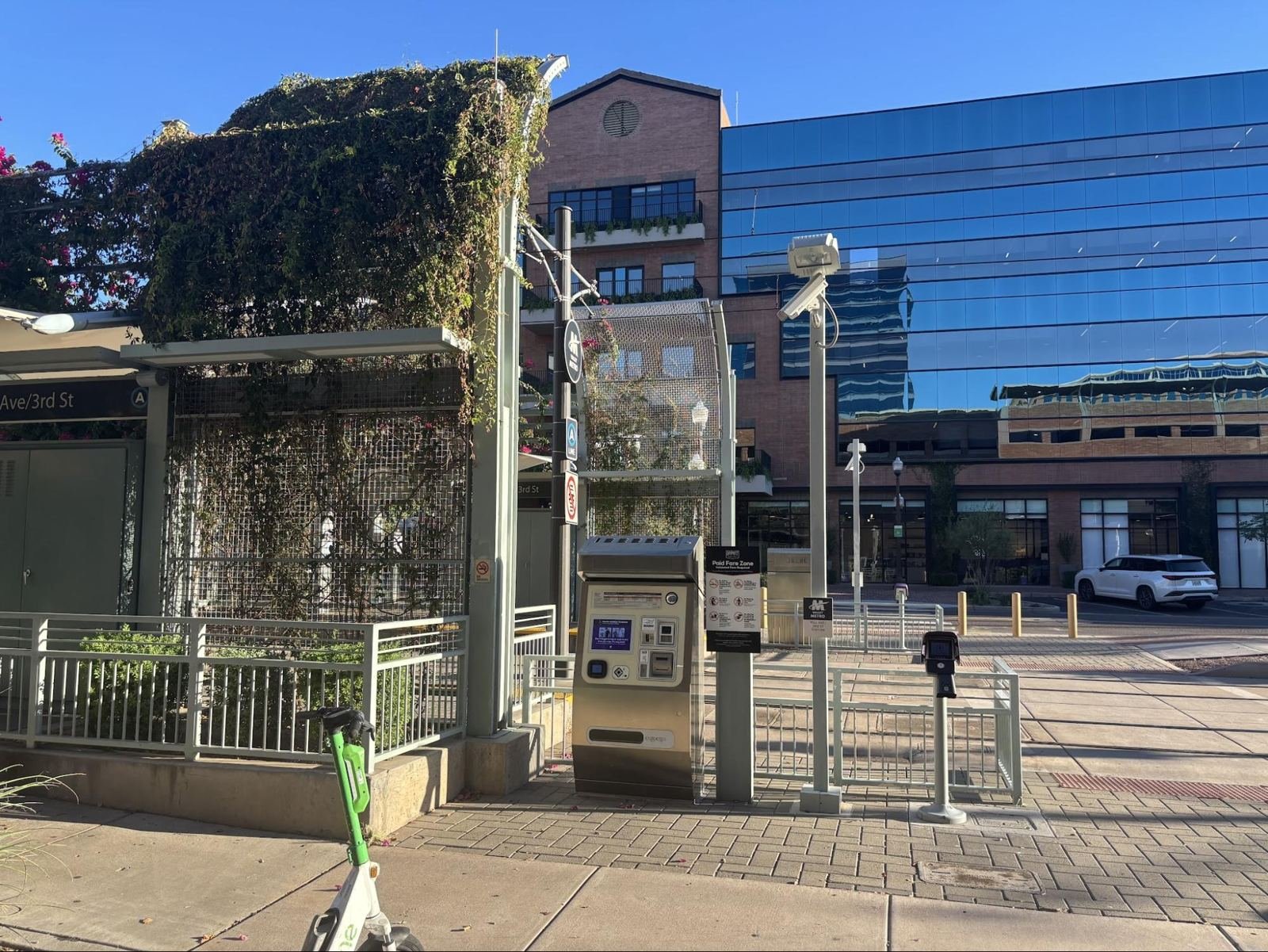
Mill Ave/3rd St station · Photo by Om Gawali
The problem
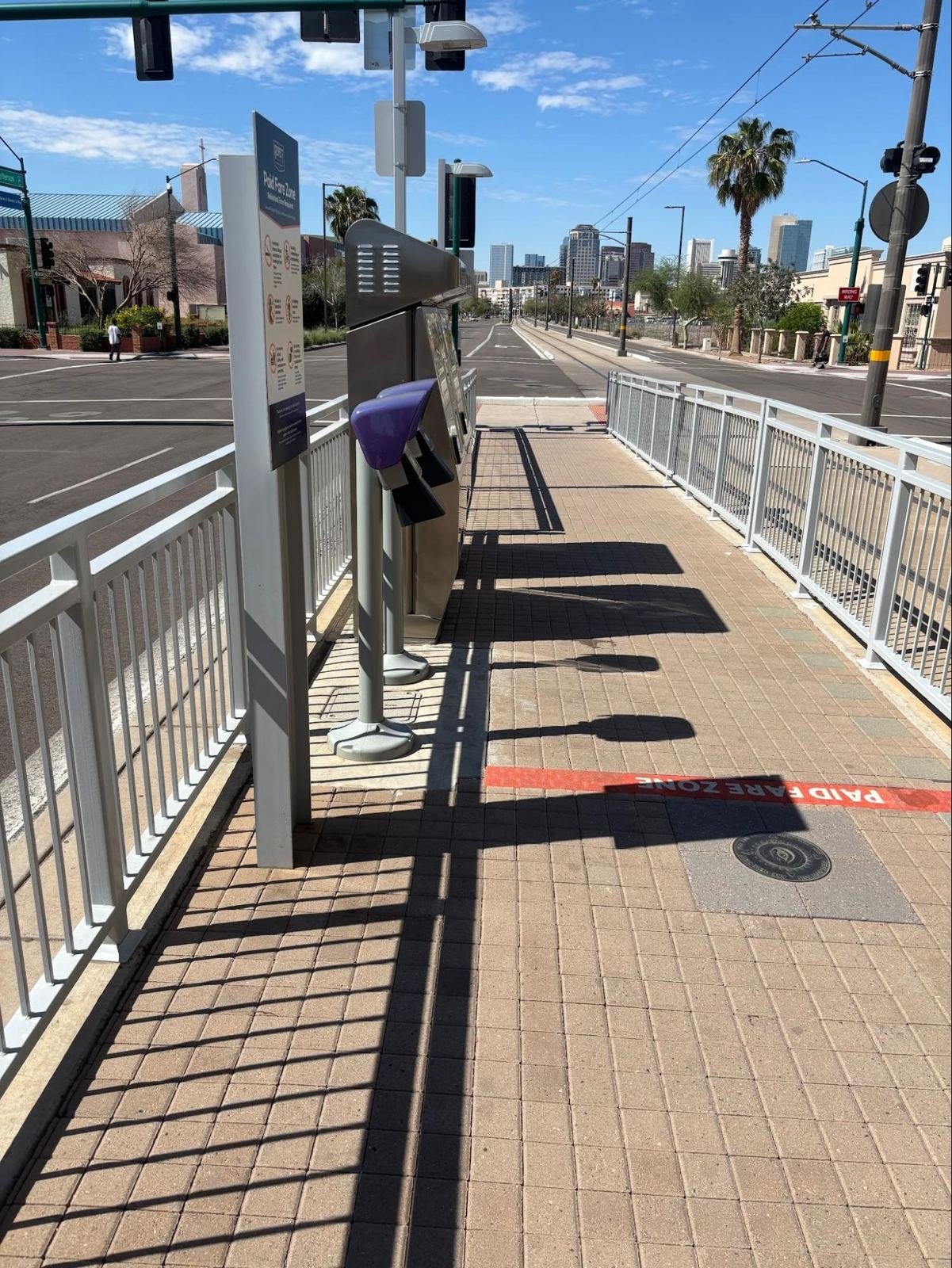
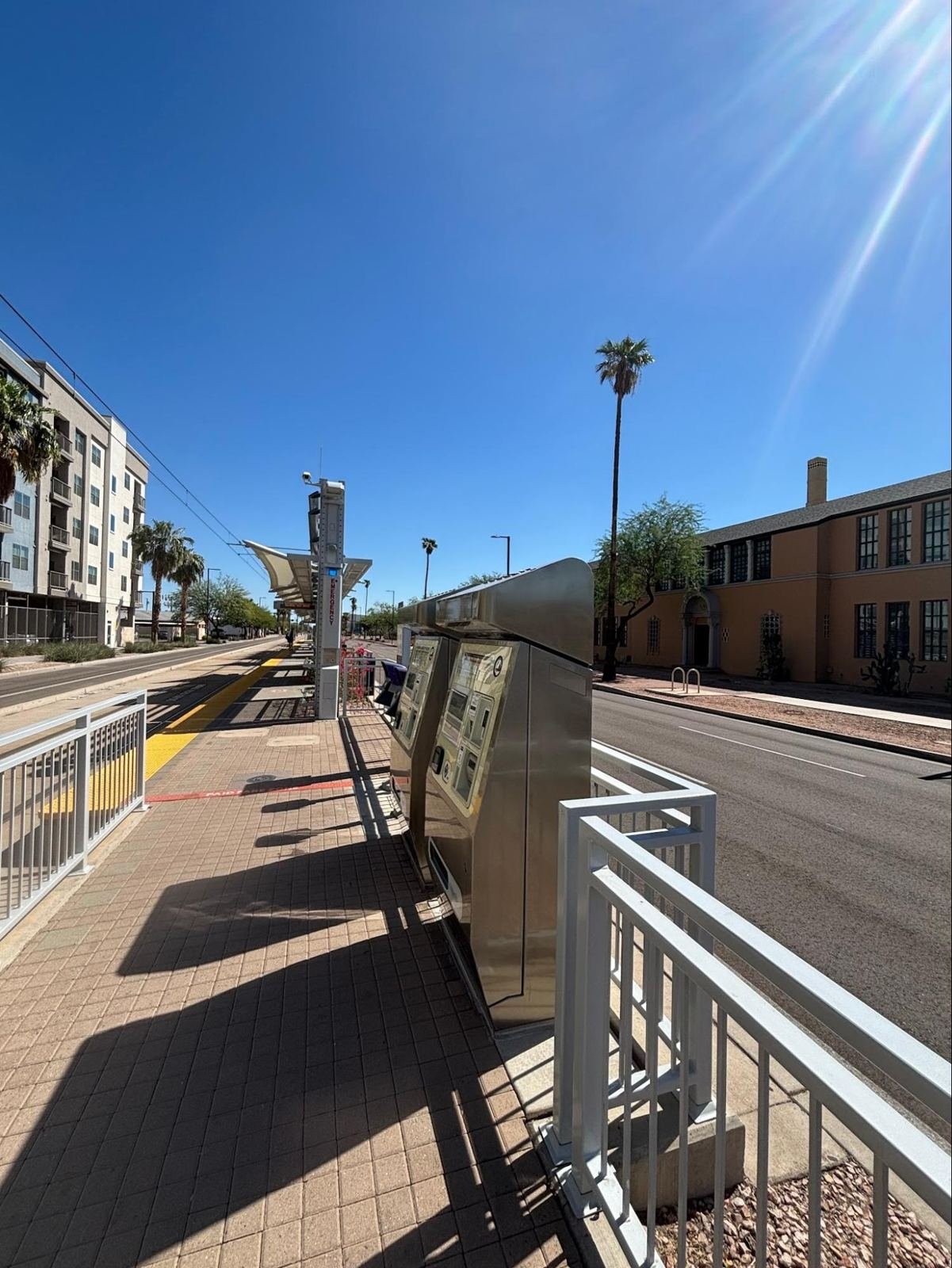
At some Valley Metro light-rail stations, fare machines and scanners sit outside the shaded waiting area. Riders stand in direct sunlight to purchase a fare, add money or scan a pass.
Consider a rider whose phone won’t scan on the first attempt. They adjust the screen, try again and remain in the sun, while the shaded waiting area is a short distance away. A routine payment problem can also become a heat-exposure problem. We’ll interview riders about what happens and time how long payments and retries take.
12th St/Jefferson station · Photos by Om Gawali
Dr. Ariane Middel explained in our interview that air temperature alone does not capture a person’s heat exposure. Standing in direct sun makes your body take on more heat than standing in shade, even when the air temperature is the same. Valley Metro staff told us they added new fare equipment in 2023–24. Where it went depended on station design, fare-enforcement boundaries, cost, security, safety and maintenance.
The problem therefore involves more than a lack of shade. It’s about where the equipment sits, how the payment tech works, the choices Valley Metro made and the different ways riders pay. Someone who uses cash or experiences a failed scan may have fewer ways to avoid the exposed payment area.
Our project asks
How did these systems combine to produce the current experience, and how can riders and agency staff co-design practical improvements that reduce time in direct sunlight while preserving an accessible, reliable fare-payment process?
One rider’s experience
My motivation to address this issue began when I failed to scan my fare before getting on the light rail to go to work in the summer. I thought the lack of shade present impacted not only the scanner’s ability to scan my fare, but also my comfort, and to a minor extent — my health.
During transit, I was asked to scan my fare again and when explaining why it would not work, I was treated like I was intentionally trying to evade my fare. As such, I was removed from the train and asked to scan my fare at the next stop. Again, the scanner failed to recognize the QR code that represented my fare on the Valley Metro app, so after about a minute wait, the train left — without me on it.
It was then that I encountered a fellow rider that had just arrived to the stop, and they expressed to me that they had found the new fare scanners so inconsistent that they would rather buy paper fare at the fare machine (that was also unshaded) and it wasn’t worth the wait for an attendant to help them, all while they were in the heat. Ultimately, they had a negative view of the system in general as a result.
It was then that I worried about the public’s trust in this system, and if it was corroding due to the lack of shade infrastructure impacting riders’ experiences with fare scanning and payments.
Om Gawali
Who cares?
Who is affected?
People directly affected include cash users, card users, riders without reliable technology, tourists, people paying for multiple riders, and anyone experiencing a payment or scanning failure. Older adults, riders with disabilities, and unhoused riders may face additional barriers.
Who has a stake?
Relevant stakeholders include Valley Metro’s fare, planning, sustainability, customer-service, security and maintenance teams; fare inspectors and light-rail operators; the agency’s governing board; and the cities served by the selected stations — including but not limited to Phoenix, Tempe, and Mesa.
Potential sources of heat and community expertise include ASU’s SHaDE Lab, Phoenix’s Office of Heat Response and Mitigation, Arizona’s chief heat officer, the Maricopa County Heat Relief Network, ASU’s new Center for Heat Preparedness, and organizations serving older adults, unhoused residents, and people dependent on transit.
Who will take part?
The pilot will aim to recruit eight riders with varied payment methods, ages, abilities and levels of familiarity with Valley Metro. This small group will provide detailed design input. We will also seek input from relevant Valley Metro staff, a heat expert and an accessibility or community-service organization. Participation by these organizations depends on their availability and agreement.
Taking part is voluntary. We will ask permission before photographing or quoting anyone, and riders can choose to stay anonymous.
Why co-design?
We understand co-design as a process in which people affected by a problem help define priorities, develop possible solutions and revise those solutions together.
Lived experience is treated as expertise alongside technical and institutional knowledge.
Riders understand the everyday difficulties of paying fares in the heat. Valley Metro staff understand equipment, operations and implementation constraints. Heat and accessibility specialists can help assess comfort and usability. Our role is to facilitate a process that brings these perspectives together.
Participants will help identify priority problems, create and compare concepts, and assess revisions. They will be able to see how their input shaped the recommendations and why some ideas could not move forward.
Project plan
Phases and methods
Weeks 1–2
Prepare and select stations
Confirm access with Valley Metro, visit potential locations and talk briefly with riders. Choose two stations and prepare interview questions, observation forms and recruitment materials. Arrange water and shaded spaces for fieldwork.
Weeks 3–4
Learn from riders and observe stations
Recruit eight riders and interview them about paying fares, heat and possible improvements. Observe each station at three daytime periods on at least two days. Record shade coverage, payment delays and how riders move between payment and waiting areas. Summarize findings with station diagrams.
Weeks 5–6
Develop ideas together
Hold a rider workshop using station photos and diagrams. Identify priorities and develop two or three possible solutions. Offer individual or phone conversations for riders who cannot attend.
Weeks 7–8
Review and revise
Ask Valley Metro and available heat or accessibility experts to review the ideas for cost, maintenance, safety and accessibility. Share their feedback with riders and revise at least one concept.
Weeks 9–10
Test a prototype
Build a low-cost version of the revised idea. Test at a station with Valley Metro’s permission or use an off-site mockup. Ask riders about comfort and ease of use. If testing on-site, compare time in direct sunlight with earlier observations and revise the design.
Weeks 11–12
Share recommendations
Create a short report and visual summary explaining the final concept, how rider feedback shaped it, estimated implementation costs and next steps.
Timeline
Apply for funding and contact potential partners during fall or spring. Begin the 12-week pilot once funding and station access are secured, ideally during warm weather. Adjust fieldwork for conditions and participant availability.
If access or recruitment is delayed, reduce the testing scope. Off-site testing can show how a concept works, but cannot confirm reduced sun exposure at a station.
Proposed budget
Item
Amount
Rider compensation
$960
Prototype materials
$600
Water, shade and field supplies
$350
Accessibility support
$450
Participant transportation
$240
Recruitment and printing
$100
Unexpected costs
$300
Total
$3,000
Each rider can receive $120, paid in cash or a gift card: $20 for an interview, $50 for co-design and $50 for testing or follow-up.
These are estimated costs. The budget assumes team time and partner advice are contributed without charge and covers the pilot. Permanent installation would require separate funding.
Deliverables
The project aims to produce a clear account of where fare-payment design exposes riders to direct sunlight and how riders think that experience should change. Deliverables will include:
A rendering of the stations’ current architecture and a description of the shade (or lack thereof) that is present and how much time riders spend in direct sun while paying.
A list of rider priorities that are categorized by type, severity, and frequency of feedback.
A summary of the systems affecting rider experiences that addresses the factors behind rider feedback and puts them in context with information from Valley Metro, the SHaDE Lab, ASU’s Center for Heat Preparedness and our own research.
Two or three initial concepts of infrastructure and at least one revised prototype or design recommendation from both involved parties.
A record of rider feedback, agency constraints and design changes.
A rough estimate of the funding necessary for shade or shade-related infrastructure implementation in accordance with local guidelines.
Depending on the retention of riders and designers, a road map will be included to outline steps to determine if further rounds of feedback are needed and if others seek to replicate this protocol to apply the practice to their own public transportation system.
Desired outcome
At least one concept that riders support and Valley Metro staff consider worth further investigation. Permanent installation is a possible later step.
Evaluation
Participation
We will track recruitment, participation at each phase and the range of payment methods and experiences included. Riders will be asked whether they felt heard and whether they can identify their contributions in the revised concepts.
On-site testing
If on-site testing is permitted, we will compare payment-related time in direct sunlight, retries and ease of movement with baseline observations, while recording differences in conditions. We will also collect feedback on perceived comfort and usability.
Agency review
Valley Metro review will identify cost, durability, maintenance, accessibility, safety and operational concerns.
What success means
A design riders want that Valley Metro agrees is worth a closer look. If agreement is not reached, the report will explain the remaining tradeoffs and evidence needed to resolve them.
Who we are
Allie Seligman
Allie Seligman is a journalism professor and graduate student in public interest technology. A former reporter, she has experience interviewing community members, explaining complicated systems and producing public-facing information. She leads audience engagement for Cronkite News and Sports and has experience designing projects around community needs. She brings interviewing, facilitation, engagement, storytelling and visual-communication skills.
Om Gawali
Om Gawali is a graduate student in public interest technology and a content strategist at the Center for Science and the Imagination, where he edits and releases resources about STEM research, science communication, science fiction, and the intersecting fields that bind them. He previously worked in the Center for Mechanisms of Evolution, studying evolutionary pathways of microorganisms. His background brings technical knowledge and public outreach experience to the project.